
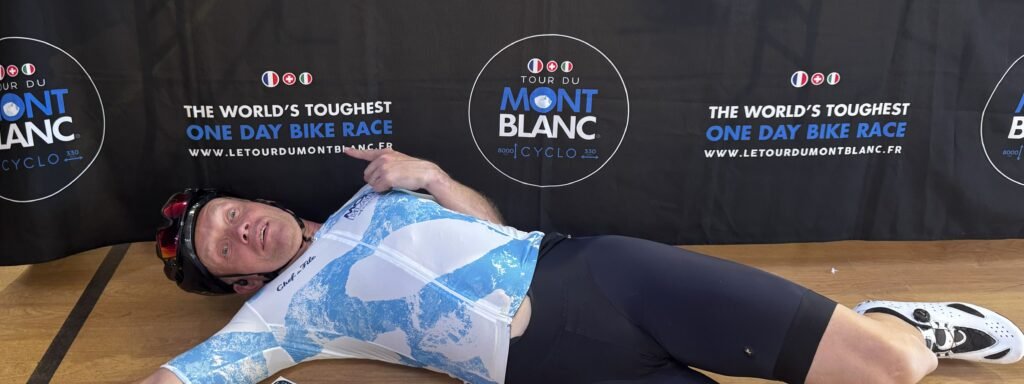
“It’ll Be Fun,” he said…
An Ordinary, Overweight Scotsman vs.
The World’s Toughest One Day Cycling Event
331 km • 8,215 m ascent • 1 day • 11 July 2026
The Invitation
It started, as many very questionable decisions do, with a friend and a throwaway sentence. He was turning 50 and was looking for a challenge to celebrate. I was 53, an age at which most sensible men are thinking about derisking their antics, not questionnaires about Functional Threshold Power (FTP), a key measurement of power on a bike. If I recall correctly, we had just completed a gravel ride pub crawl, 22 miles, 14 pints at Christmas. What could go wrong?
“It’ll be fun,” he said.
Reader, for me, I continue to reflect, searching for the “fun” element of the challenging event. It was over 330 kilometres and close to the height of Mount Everest in a single day around the tallest mountain in the Alps, with a midnight cutoff having been up at 3am (UK time), hail, painfully heavy rain, a strong headwind, an ambulance cameo, and nearly nineteen hours of me negotiating with my own legs. But we’ll get to that.
Now, I normally live by “better to say you are glad you did than you wish you had.” I’m usually first in the queue for a challenge. Riding Lands End to John O’Groats twice, 1000 miles in 10 days, day events of 235 miles Trans-Wales, over 200 miles across the North of England and Ireland “Chasing the Sun,” and with my kids and a naively with minimal experience, kayaking “the great glen” and Aonach Eagach are all safely complete but those are not billed as the toughest events in the world!
This one however!!! It had me stalling my committal for months, an unusually tentative bout of scepticism for me. My scepticism, in fact, never really left. It just eventually got outvoted by peer pressure, which, it turns out, is a hell of a training partner.
Let’s be clear about my credentials: I am a keen but, in my opinion, ordinary cyclist. I have to work hard to stay in the faster groups on club rides. I am invariably last in club races. I climb at a pace akin to a tortoise and enjoy my food wholesomely. Despite previous accomplishments, I have never climbed the vertical equivalent of Everest in one sitting and the most climbing I ever did a day at just over half that left me in recovery mode for weeks. There’s “keen amateur” and there’s “certified lunatic,” and this event lived firmly in the gap between the two, daring me to cross it. That said, too many of my friends think I have…
The Great Winter Diet Overhaul
I came back from a hearty Hogmanay at my heaviest ever, roughly two stone over where I needed to be, carrying a “reasonable base fitness” and a stark realisation of the challenge ahead. So I did what many folk do: I considered my options, then googled.
First came the keto diet, which was reassuring for the scales, 95kg down to 88kg in 4 weeks, yet catastrophic for actually pedalling a bike, since a fair chunk of that was clearly just water leaving my body and a sole destroying loss of energy! My ability to complete in online Zwift races, plummeted. Having seen some YouTube videos advocating a 3 day sardine “fast,” was it for the better remains to be determined but certainly caused humour amongst my friends. I abandoned keto and tried, with the grim resolve of someone starting dry January in July (too close to the truth!!), to simply eat better. This is a genuine struggle for someone who loves food and beer even more than he thrives on cycling, which is to say: a great deal.
My Zwift racing weekly with the club left me finishing near-last with impressive consistency. A man in his own private Tour de France of mediocrity, weighing in at around 14½ stone with an FTP hovering around 245. I learnt by default that CO2 was building up in my garage which may too have impacted these dire results.
I fed all this into ChatGPT and asked it, essentially, “what’s the minimum wattage I need to complete the event.” Anything to help me both have some belief I could do the event and understand my required targets.
Assembling an Arsenal of Marginal Gains
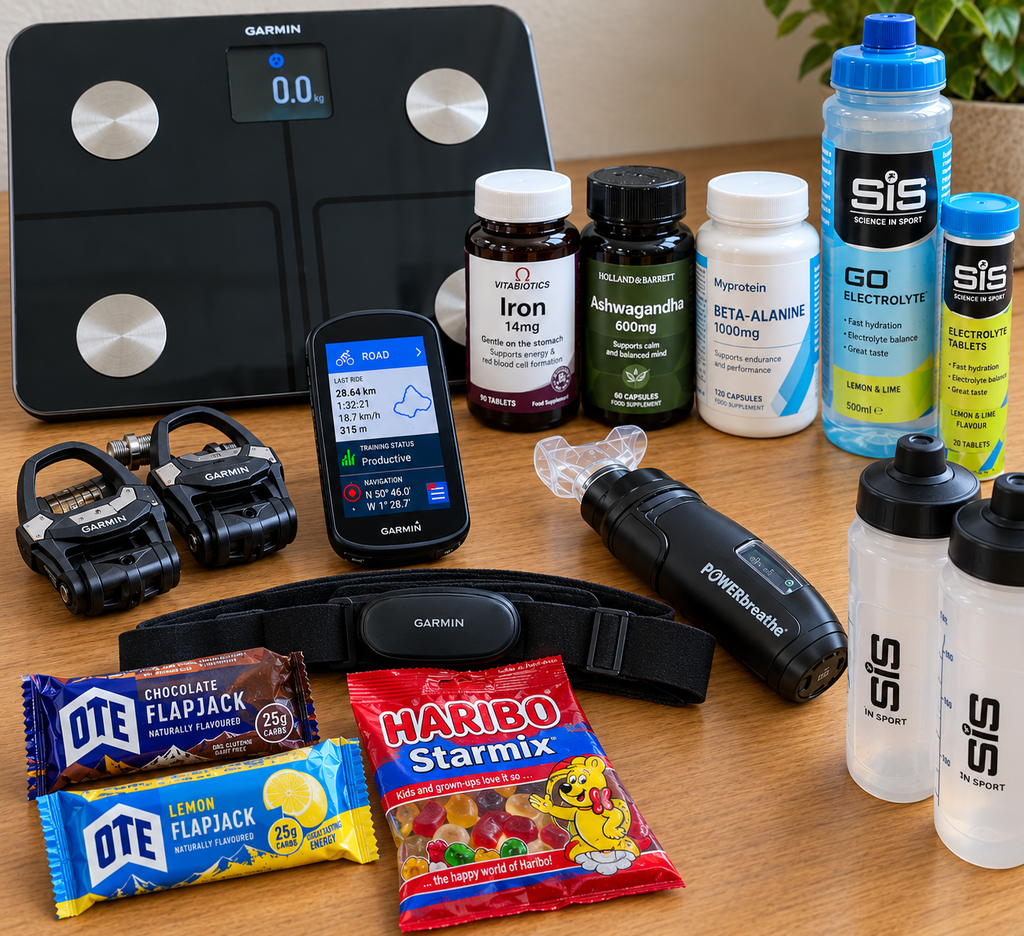
I decided my lungs were a weak link as despite playing the bagpipes, high intensity efforts left me gasping. In hindsight, possibly not aided by the CO2 build up so I bought a Powerbreathe. After several failed starts due to personal discipline, the device equivalent of a gym membership used twice in January, best intent but failing commitment, I actually got into the habit. I added stretching, courtesy of YogaGLO videos, though “more often” doesn’t necessarily mean “enough.” Weights, once a week, dutifully, like flossing! I enjoyed the weights but fitting it in with cycling for optimum benefit and recovery was challenging.
I also signed up for an AI coach, CoachCat, for a structured training plan, approached with the optimistic enthusiasm of someone adopting a stray dog they’re not sure about. My more experienced friends were sceptical. My FTP was also sceptical, refusing to budget throughout and casting doubt over the effectiveness of the AI so I questioned it. The response, “Would you rather a number on a screen or to complete the event.” Both I thought but fair point. Questioning it on social media encouraged me to persevere, gradually getting fitter with CoachCat’s help.
Google indicates coaching data, and event preparation profiles for the event outline the baseline requirements needed to finish. A minimum of at least 3.0 Watts/kg just to finish within the official time limits and a comfortable finish requiring 3.5+ W/kg to manage the massive elevation changes and prevent severe fatigue. In January my watts per kilo was 2.6! Work to do! Calorie deficit while training hard was not easy though.
With CoachCat’s optimal recommendation, breakfast became a ritual worthy of a small religious ceremony but looking somewhat akin to what is known in Scotland as a pavement pizza: 70g porridge, 20g chia seeds, 30g protein powder, super-greens, creatine, 150g Greek yoghurt, 150g skimmed milk, 100g berries. Seriously! My wife described the mire as resembling a bowl of vomit! Nice!
Then came the supplement rabbit hole. Ashwagandha, according to google aiding recovery. Beta-alanine, for buffering acid buildup, which apparently needs a two-month head start, so I began necking these concoctions as if loading up on ammunition. Iron supplements went in for the final fortnight, to maximise red blood cells, because by this point I was essentially trying to biohack myself into something beyond my capabilities.
Somewhere in all this, my carbon bike’s frame cracked and needed repair. Why couldn’t preparation be simple? I also took up open-water swimming, on the theory that anything that stretched me out and improved my lungs was fair game as I had watched a you tube on that somewhere too. If it’s on You Tube, it must be true, NOT! Swimming in 9 degrees water was, lets just say, character building, brief and left me initially taking about 8 hours to warm up again!
The Body Betrays Me
Then my back started hurting, right after I rebuilt the bike to my professional bike-fit measurements. Irony has a wicked sense of humour. Physio and sports massage became part of the routine. The day before the event, in a plot twist worthy of a sitcom, I discovered my saddle was 5mm too high! 5 minimal but all essential millimetres. A margin so small it’s basically a rounding error, and yet apparently the critical culprit all along. Weeks of physiotherapy, undone or rather, explained and resolved by the twist of an allen key.
Discipline, meanwhile, remained a work in progress. I stuck to the CoachCat plan reasonably well, right up until a friend suggested a ride, at which point my willpower for the plan evaporated like morning dew. Weights went from twice a week, to once a week as CoachCat tuned me in. I clung religiously to tracking food on Nutracheck, feeding my daily macros to CoachCat and asking what I should eat for the rest of the day, advice that was, remarkably, always spot on, even suggesting exactly what to eat. I also read and watched everything I could find on training and nutrition, because if I was going to fail, I was determined to fail having tried everything and learnt.
Logistics of an Ordinary Man Trying to Do an Extraordinary Thing
The all vital feed stations were an unknown, particularly as all advice says so not eat or try foods your body is not familiar with on race day. Nor did we want to carry a whole day’s food, approximately 10,000 calories due to the bulk and weight. A friend who’d done the event before warned the stops weren’t great. We wouldn’t actually find out until the day itself, which is a very on-brand way to attempt the toughest cycling event in the world!
In the meantime, I turned snack and hydration selection into a small science project, testing electrolytes, energy drinks and flapjacks like a man auditioning contestants. Precision Fuel energy drink won out, alongside flapjacks and, despite my Niagara Falls sweat rate turning out to be surprisingly low in salt (thanks, Precision website, for that reassuring insight), SIS electrolytes. And Haribo. Obviously Haribo, non-negotiable event fuel for cyclists everywhere.
Hydration was critical, and I found salvation in Elite’s “Fly” bottles — 950ml and incredibly light, at least psychologically, the marginal gain equivalent of finding a fiver in an old coat or maybe a quid! I tried calculating when I should refill these. To be sure, I opted for, at every opportunity and ended up carrying about a bottle too much the whole way!
For the previous Christmas, I’d asked for a sweat suit for heat training (as I saw it helps on You Tube!) and then, showing the enthusiasm of a turkey approaching December, put off using it for as long as humanly possible. I trialled it a few times before our training week in Samoëns in the Alps, four weeks out from the ever increasing nerve racking event date, 11th July. In Samoens I had a stark realisation, I was still too heavy, but great for climbing practice. For an overweight Scotsman more accustomed to drizzle than sunstroke, the heat was genuinely torturous. Necessary, hugely advantageous, fun but torturous.
In Samoëns, unable to keep pace with my friends’ significantly superior watts-per-kilo, I climbed the local Cols on grit somewhere dissolved in my reservoirs of sweat: l’Encrenaz (1433m), Ranfolly (1656m), Joux Plane (1691m), Colombière (1613m), Jambaz (1027m) and Ramaz (1619m). All perspiring profusely and feeling and looking close to spontaneous combustion. My friends mocking me with jest, chatting to me up the hills as if we were sat in the pub over a pint. Me silent, thinking, OMG! My head, that week, was a complete stew of chaos; looking back, I think the sheer scale of the event was quietly gnawing away at me. My friends, both accomplished Ironmen but ever helpful, informed me I was still eating too much. Possibly true. They also pointed out that four weeks out was no time for a calorie deficit. I ignored them though a family holiday in the middle of all this didn’t help; irresistible French bakeries, Belgian pretzels, sumptuous ice cream and Dutch beer proved, shall we say, more persuasive than my nutrition plan. Hey ho.
Equipment decisions rounded out the preparation: a “Piggy” bag, was recommended for minimising what I carried. How apt I thought, given my physique and fodder devouring capabilities! Roval C38 wheels and 32mm Grand Prix 5000 tyres, chosen not out of aerodynamic genius but because they were in a sale. Proof that beneath the lycra was the heart of a genuinely tight-assed Scot. I’d have preferred 30mm tyres like my friends, but a sale is a sale. Gearing was discussed to. I was naively thinking 52/36 chain rings with an 11-34 cassette, until persuaded into a 50/34 chainring paired with an 11-36 cassette. In the event so very wise a recommendation for the insane mountains looming closer. I read that paracetamol can dull the pain of lactic and heavy exercise, everything and anything was worth a shot. Ibuprofen was recommended against. I also took salt sticks which I had never taken before but there was every sense in trying them too, albeit no one would advocate trying anything for the first time during the actual prime event of the year and toughest event of a lifetime!
My Training Peaks fitness score peaked at 115 from a low of 47 the previous December. I did manage to get myself down to 84kg, lighter than I’d been since my teens; though my FTP, at least according to Garmin auto-tracking and FTP tests, stubbornly refused to shift from the 250 I’d started at. Which left me with a, all critical watts-per-kilo of just under 3, a number which even optimists might call ‘ambitious’ and realists might call ‘delusional,’ in attempting the event.
By the time it was all done, I genuinely hoped more than being certain, I’d covered everything even if my stats indicated I was heading for failure. I was as ready as I was going to be.
Race Eve
With a 3am UK-time (4am in France) wake-up the start an hour later looming, I made a half-hearted attempt to reset my body clock, for both sleep and, delicately put, “nature’s call.” Success was limited on both fronts.
Three of us made the long drive out two days before, treating ourselves to a ferry upgrade with an all-you-can-eat buffet, though calorie intake at this point was pretty important, a balance of carb loading with minimal alcohol and avoiding weight gain. The upgrade was more to stock the bags with a copious stash of flapjacks for the road. We rested the day before, save for a short, gentle leg-opener up the mountain from Les Saisies, the start and finish point.
Final bike check done. Di2 charged. Fresh batteries in the Garmin power pedals and heart rate monitor. My friend, a bit of a data nerd, bless him, had pored over the course and identified, to him several but for me, one crucial insight: those who finish do not linger at the stops. Noted, filed & a clever and fortuitous observation, as it turned out.
I’d loaded my bike computer with the Garmin power guide that proved far too detailed to be useful, and, courtesy of ChatGPT, had settled on a target of 180–220 watts, which sounded sensible on a laptop at home. In reality not the case. At kilometre 113 with over 200 to go, in a temperature over 30 degrees on a Swiss Alp in July. I split the event into 4 different routes on my Garmin with the three intermediate cutoffs and a final deadline of 00:00.
I was nervous. We’d met precisely one other person who’d done the event before reinforcing this. My friend who’d said the feed stations weren’t great is a much stronger cyclist than me and he hadn’t actually finished the event, missing the second cutoff by half an hour. Nobody said it outright, but bar my closest friends, I got the strong impression the general consensus was that I wouldn’t make it. I was still overweight, my FTP had sat stubbornly at less than the critical 3 watts per kilo and we had no idea what was in store, tarmac conditions, feed stops nor the enormity of those climbs never attempted before. I’d normally have done an event like this for charity, but I was so unconvinced I’d finish that I decided against. I’d like to believe I have grit though.
Still. Tomorrow, best endeavour, and all that.
The Day Itself
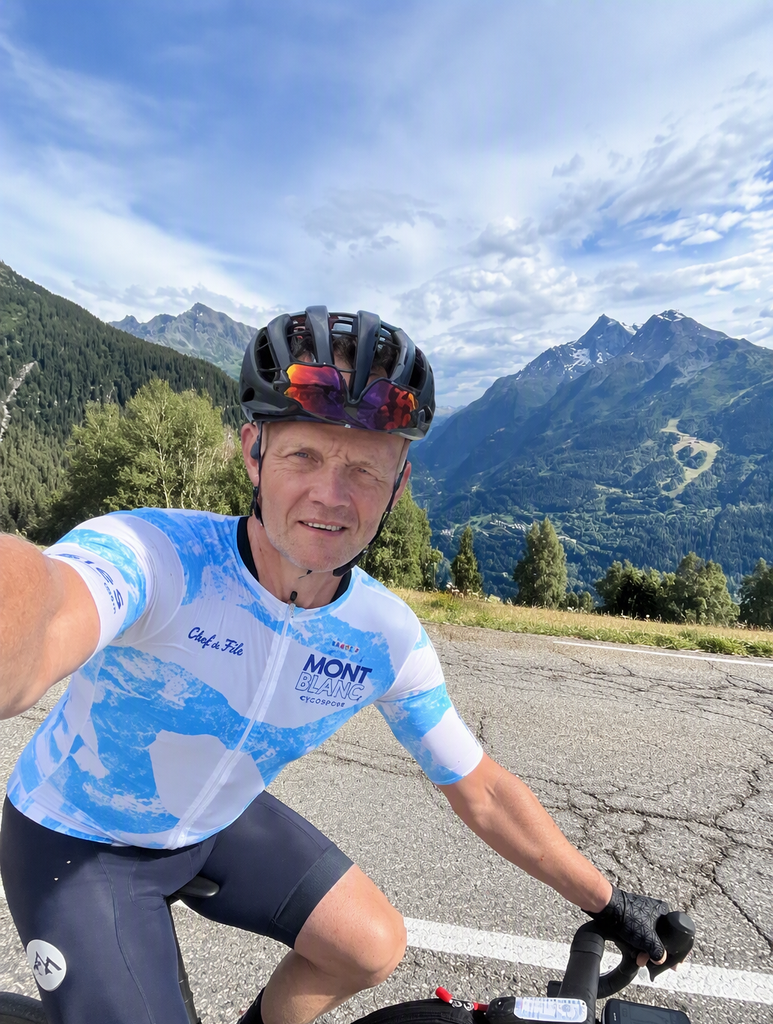
Up at 3am. Standard breakfast, concocted the night before and executed with the solemnity of a pre-flight checklist. Nature’s call delayed my exit from the apartment, so I set off behind my friends, dark, cool, short sleeves already, on the promise it would soon warm up. Around 500 eager participants milled at the start, buzzing with the particular nervous excitement of optimists attempting the faintly ridiculous.
My friend suggested we descend together for the first stretch. Normally I’d have loved that, but comparative to others, descending is one of my few perceived actual strengths (no doubt assisted by my extra avoirdupois!), so as politely as I could, I declined the suggestion. The start itself was amazing, 500 or so riders descending with the procession of candle like front lights flowing down the mountain. It was however somewhat chaotic: riders stopping dead mid-road for dropped bottles, weaving through obscured obstacles amid general jubilation. I started near the back and was on form, buzzing through the first 10km of, descent! The descent most likely giving false assurance of my form. As far as I am aware, only one rider overtook me on any descent the entire day.
Then the climbing began. Manageable at first, even pleasant in the cool morning air. By 107km — the 11am cutoff — I’d banked 1,820m of ascent, well ahead of schedule at 09:15 though in hindsight this perhaps created misplaced confidence as it included a net elevation gain of minus 1,160m. Mindful of my friend’s warning about lingering, I spent barely two minutes at the stop before launching straight into a 14km, 7% “taster” climb. Our first glimpse of the descents still to come followed, long, fast, switch backed affairs that, critically, played to my strengths.
Then, at 113km, came the Grand-Saint-Bernard: 25.6km, 1,572m of climbing, and the sun now fully awake and out for blood. This was close to double the length of ascent I had ever done before. I wilted. Genuinely, comprehensively wilted. My ETA for the second cutoff sliding backwards in real time, and my brain became a looping tape of “how am I going to get this done,” “it’s too hot,” not even 6 hours in, “time is running out,” or rather, considerably more colourful versions of those sentiments. I fought my psyche with the only tools I had; lose the negative thoughts, one pedal stroke after another, do what you can. Through a couple of tunnels, the grind was relentless, but I reached the top, briefly triumphant, then the sky opened.
Hail. Then torrential, needle-sharp rain. We crammed under a gazebo like commuters on the London underground at rush hour. Jacket on, shivering, painfully aware of the clock, I decided now or never, onwards relentless. Staying still would only make me colder and my chances of completion worse. By this point I believed I had one friend ahead and one behind. Shortly after I left, as it turned out, the one behind was stopped as the organisers ended the event there so one friend was sadly out. The weather had made it too dangerous, a wise but unfortunate decision. I descended as one of only three riders daft enough to do so shivering uncontrollably, wet through, hoping it would dry up at the bottom. Tucking in behind another rider who overtook me, I used him as a guide to both the road’s route and its condition. That descent clawed back roughly an hour and carried me past the halfway mark. For the first time, I let myself think: maybe I can actually do this. My goal was to just finish the whole route, my stretch goal was to finish by the start line closure at 12:30am and the unforeseeable event goal was to finish by midnight.
Mercifully, at the bottom, the only section of relative flat, the storm had been a one-off, though a stiff headwind over the 30 km flat did its best to compensate. Looking at the route profile it doesn’t look flat but comparatively it certainly felt it and it led to a much craved and perfectly positioned pasta stop. A genuine gift to a body starting to repel sweet snacks. Mid-mouthful of pasta, a call came through from a friend who was watching from his sofa while enjoying the Tour Du France: “Keep going, you can do it, you are on track but you need to keep moving.” I downed the pasta and left.
Next up: the Petit-Saint-Bernard, a climb whose name is somewhat misleading. 22.9km and 1,183m of climbing, nothing “petit” about it whatsoever. Eventually I crested it, grafting hard more time lost on my ETA but optimistic. I bombed the descent, pushing hard through switchbacks and, memorably, through the spray of farmers irrigating their crops, arriving at the next cutoff, the big one I’d been mentally circling for months, 19:20 against a 20:00 deadline. The back of the event was broken. Another call: you can make it to the cutoff, but you’ll need to speed up. “Eh — I’ve already made it,” I told him, in the fog of exhaustion and confused by mild delirium. It turned out the event tracker simply hadn’t caught up with me yet.
Onward into the third of four stages: 21km of near-continuous ascent, with a grand total of 50 metres of descent thrown in as a cruel joke. By now I’d long since accepted that 180–220 watts was a fantasy invented by a chatbot devoid of human physiology. I was managing an average of around 150 watts and making my peace with it. I hit the final cutoff with ten minutes to spare, just missing what must have been a glorious sunset while fumbling to get my lights on and layer up against the sudden chill induced as it became daylight diminished.
The diminishing light made for a more challenging final descent through the forest which obscured, felt like the worst tarmac of the day. I was elated, putting mountain biking experience to the fore across the bumps but buzzing on the thrill of the fast descent, overtaking rider after rider by following their bobbing lights ahead of me. At the bottom of the last climb, I felt almost — almost — confident. Refreshed by the descent, ready for one final steady 14km grind. Then it hit me: total, bone-deep exhaustion. Ten kilometres of climbing left. The finish was in sight yet I felt genuinely rough — possibly from effort, possibly from an industrial quantity of sugar. Cars passed, horns blaring in encouragement. Sadly I could not have been less in the mood for celebration. The motivating and distracting music from my bone-conduction headphones had died hours earlier, leaving me alone challenging my psyche, which by this point, was a drought of the stronger psychological resilience of earlier. Not great company for the celebrating horns of celebration and encouragement. All I wanted was silence to keep me focused on the mission.
The kilometres ticked by with agonising slowness. 11pm, which I had aspiration of finishing by came and went. Midnight loomed ever closer, concerningly closer. A mile from the finish, I had to stop. I felt too rough to continue. An ambulance pulled over to check on me. I was determined to finish even if it meant walking the rest. Five, maybe ten, minutes lost just standing there, wondering, quite seriously whether I’d miss the midnight cutoff, and whether if etiquette would even allow me to wear the finisher’s top and gilet if I did.
I got back on. Grinding, sweating, nauseous, and asking myself, with some bitterness, exactly which part of this was supposed to be the “fun” I had been assured of. Empty.
With 11 ½ minutes to spare, I crossed the line. Done, physically, mentally and emotionally done.
The Aftermath
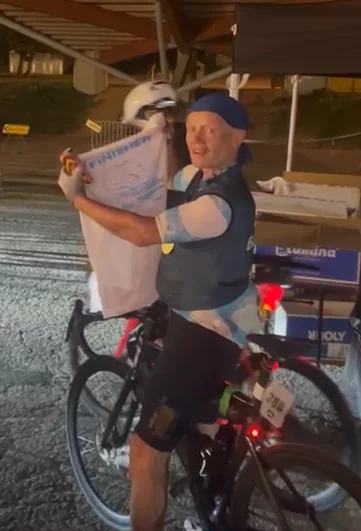
My friends were there waiting. I spent a few minutes slumped over my handlebars, utterly wrung out, emotionless — just done. The marshall put his hand out to congratulate me and put the medal around my neck. I looked at him, for a moment at least, numb, unable even to comprehend what he was doing. Medal round my neck, coke in hand, my friends taking my bike to rest alongside theirs. I was glad of but unable to appreciate their jovial celebration. I made my way to the dining hall. The food was good, by all accounts. I could barely touch it, and conversation wasn’t really on offer either. But a beer? Yes. Always yes. We watched a bit of the World Cup with one on the way back to the apartment. An calming end to a thoroughly extraordinary and predominantly un-fun day that I would, absolutely not rush to repeat. Little wonder we only met one other who had ridden the event before. The descents, the scenery and the achievement were all however incredible.
My outside hope was to do it finishing sometime in the night as some did, my goal was by the finish line close at 00:30 and my ultimate stretch was by midnight. How, I have no idea but I somehow contrary to the data and my own belief, I had completed the toughest 1 day cycling event in the world! Over the hill age wise, overweight, a few health concerns and against the odds, mission complete.
“It’ll be fun,” he said.
He wasn’t wrong. I thoroughly enjoyed the weeks abroad and training with the lads. My friend just left out the small print that the event would be questionably “fun.” Billed as the toughest one day cycling event in the world, is likely very accurate.
The Reckoning
The emotion that followed was surreal. Bone-deep, soul-questioning exhaustion yet the disbelieving question of how I had managed to accomplish it was the more dominant thought. My back stayed sore for a good six weeks, a lingering souvenir from the 5mm saddle adjustment. My legs took their sweet time coming back online, probably not assisted by a 2000-meter descent walk in Samoens 2 days later. Goodness only knows why. For a while, I needed a break not necessarily from cycling, but from the entire lifestyle of macros, supplements and focussed self-optimisation that had consumed the year to date. Regrettably my weight came back with aplomb.
My friend, naturally, was cut from different cloth entirely. He’d finished a full two hours ahead of me and was, somehow, up for another 100km ride just two days later. Incredible and I am yet to be convinced entirely human! He has gone on to enter the world qualifiers 2 months later.
Would I recommend it? That depends entirely on how hard you like to push yourself, and how much you enjoy negotiating with your own willpower at 11pm on a French mountainside after 18 hours in the saddle and more to be done.
Lessons learnt?
I learnt a huge amount about training, about nutrition, about pacing and rather more than I expected about my own capacity for stubbornness and capability. It’s not something I’d ever have attempted and most definitely not completed without my friends’ kind, patient but relentless persuasion. I am however glad I did it for the self-actualisation and delighted to have had the experience and learnings.
Lessons, revived and new;
- Your body can achieve more than one believes. A cliché but true. In differing ways, my father is to be thanked for inspiring that in me.
- Thinking positively is critical. If I had dwelled on the heat and pain of the first climb I would not have succeeded. You can if you think you can. What the body can perceive it can achieve. Mind over matter.
- I should have/could have lost an extra half stone but this is difficult to do during focussed training so I should have dieted in the autumn. Keto is great but not during training. I didn’t, for this reason, quite give myself the 100% maximum chance of accomplishing the event.
- FTP isn’t everything. I challenged the AI coach, CoachCat, when my FTP was not increasing and it rightly said, “Do you want a number on a screen or to achieve your goal?” Fair point. I had asked ChatGPT and CoachCat what was the minimum average watts to complete the event at my weight and it was incredibly accurate at 150 watts. I did 147 watts average. Both paracetamol and salt sticks definitely helped.
- My garage needs ventilation to prevent the CO2 build up which very likely hampered my Zwift races but not necessarily the event.
- I have a remarkably forgiving wife! Thank you.
- Did ashwagandha, beta alanine etc work, I have absolutely no idea!
I won’t be doing it again. For me, that particular headcase quota has been filled. Over to the next lot of lunatics who fancy it. Enjoy!


A fascinating story of both the build-up to, and the actual event itself. Sometimes it’s easy to get lost in the numbers, but in the end it’s what’s ‘inside’ that makes the difference. The mind is a very powerful tool.
The storm hitting is an important reminder that not everything can be controlled on the day, so you have to be ready to adapt.
Thanks for sharing your thoughts and experiences.
Many thanks Simon